FOR EBAY AND LOCAL PALLET RESELLERS
Check a pallet
before you bid.
Review the categories, condition and costs. Compare resale scenarios, then track what actually happens.
Unlimited category checks are free. Optional AI tools are metered separately.
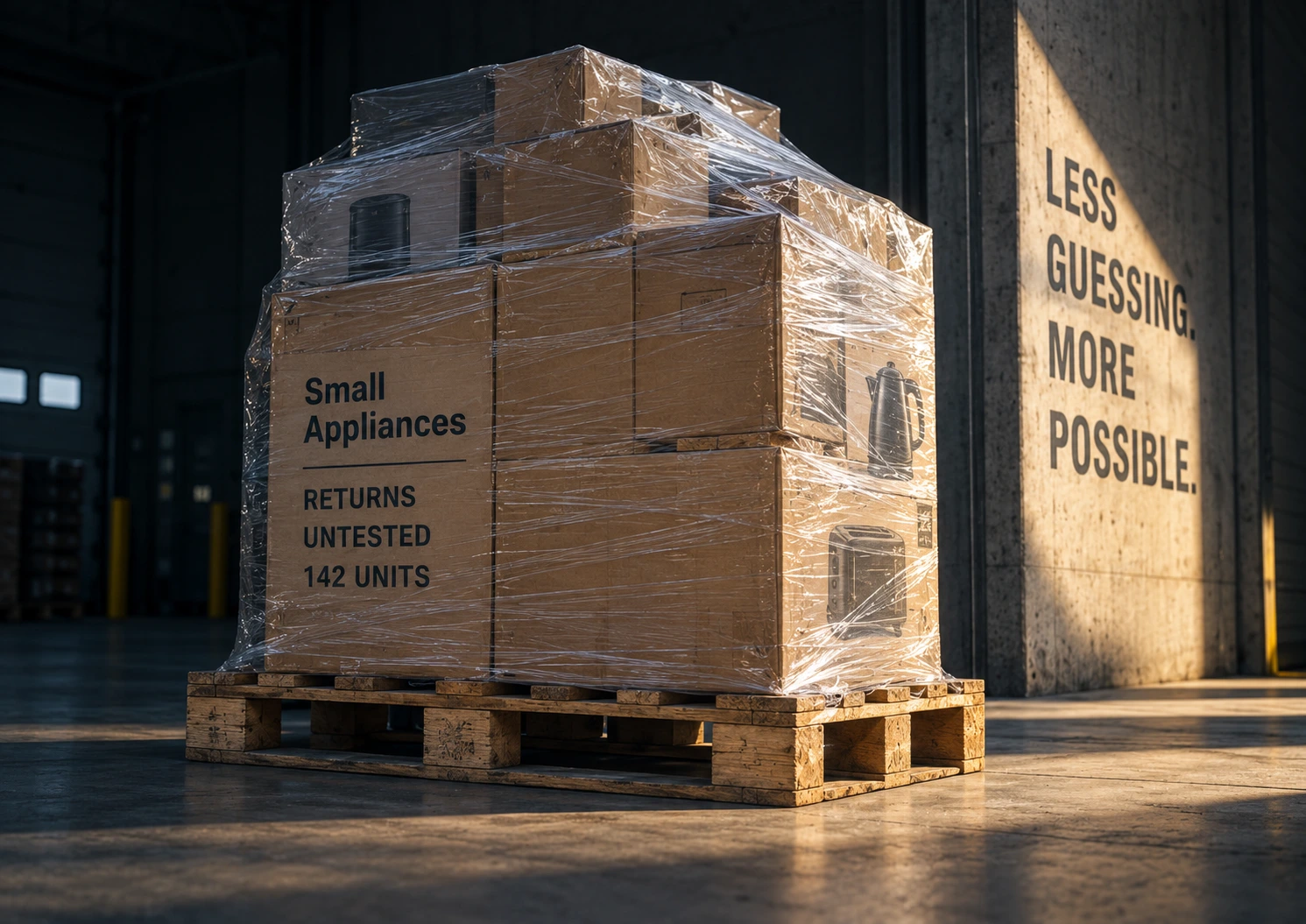
From a messy manifest to a clearer plan.
Illustrative · provisional assumptionsSmall appliances · 142 units · untested returns · 90-day window
Manifest
Start with the supplier’s file.
| Description | Qty | Stated condition |
|---|---|---|
| Toaster | 6 | Used |
| Air fryer | 4 | Return |
| Coffee maker | 8 | Untested |
| Blender | 5 | Used |
| Space heater | 3 | Return |
116 other units · 142 units total
Reviewed groups
Confirm what the estimate uses.
- Category
- Small appliances
- Quantity
- 142 units
- Stated condition
- Untested returns
- Scenario window
- 90 days from receipt
Bid scenarios
Estimated cash recovery, after selling costs.
- Conservative
- $1,800
- Base
- $2,600
- Optimistic
- $3,400
Under conservative assumptions · $135 surplus target
Acquisition and outcome
See the full cost of the bid.
- Bid
- $1,350
- Buyer’s premium · 10%
- $135
- Inbound freight
- $180
- Total acquisition cost
- $1,665
after acquisition$135
Examples, not observed results or a guarantee.
A simple workflow from bid to results.
Walk through a palletAssess
Review the manifest and run scenarios.
Receive
Track what arrives and its condition.
List
Prepare listings and record costs.
Record results
See the pallet’s recorded results.
Know what the numbers depend on.
Messy descriptions do not have to stop a category check. Start with the quantities and retail totals you can read, confirm the groups, and keep unknown stock visible. Working condition and selling within your timeframe are separate assumptions.
PalletMath does not have a completed user-sales dataset today. The beta uses assumptions you can inspect and edit; sourced product price evidence is shown when available. Your complete pallet records will help us measure future accuracy.
Read the evidence and limitsStart Free.
Unlimited category checks and saved assessments. Track your first purchased pallet through receiving, stock and sales. Basic Pal help and your own record exports stay available.
Keep finishing purchased pallets and accessing your records when paid or beta access ends.
PalletMath Plus · $19.99/month
Run multiple pallets in one workspace: receiving, inventory, sales and books, comparisons, new connections and routine automation.
Optional product research, AI listing drafts, photo identification and scanned-manifest reading are metered separately. Plus includes no AI credit.
Compare Free and PlusFair questions.
A clearer buying decision starts with knowing what is still uncertain.
What if the manifest descriptions are messy?
Use readable quantities and retail/MSRP totals. Confirm the category groups and stated condition, and keep uncertain inventory marked for review. A category check does not require an exact product match for every line. An unknown category still needs your review.
Where do the numbers come from?
Displayed category, condition, selling and cost assumptions support the beta scenarios. A product price reference has a source when available. PalletMath does not have a completed user-sales dataset today; an assumed rate is not a verified sale.
How is the bid limit calculated?
Choose a scenario and target cash surplus. The conditional bid limit is the purchase price that leaves that surplus after the scenario’s selling costs, buyer’s premium, freight and other included acquisition costs. Review every assumption before relying on it.
Does open box mean it works?
No. Open packaging and tested working condition are different. Review the working-yield assumption, and record what you find when the pallet arrives.
What do Free and Plus include?
Free includes unlimited category checks, saved assessments and tracking your first purchased pallet. PalletMath Plus is $19.99/month for multiple pallets and the full workspace. Optional paid AI tools use separate credit and show their charge before use. Your recorded purchases, basic exports and the work needed to finish those pallets remain accessible after Plus or beta access ends. Existing research subscriptions keep their agreed terms and full workspace access while active.
How does the 90-day beta work?
The first 25 eligible participants can explicitly join from Billing after verifying their email, subject to availability. Your 90 days of full-workflow access start when you join, measured by server UTC time. No card is required, and the beta never converts to a subscription or charges you automatically. Optional paid AI tools remain separate. A claimed place is not reopened or extended.
Can I track local sales and unsold stock?
Yes. Enter sales and costs in your ledger, including local sales. Record an outcome checkpoint with what arrived, what sold, what remains, returns and additional cash costs. Reconcile the whole pallet before marking a checkpoint complete.
Does the result guarantee a profit?
No. The scenarios depend on the inputs shown and may be wrong. They are not calibrated probabilities, guaranteed bounds or a substitute for inspecting the goods and reviewing supplier terms.
25 places. 90 days to try the workflow.
Verify your account, then explicitly join on Billing while a place is available. Your 90 days start when you join. No card and no automatic subscription; optional paid AI tools remain separate.
Get product updates.
Receive product and launch updates. This email list does not create an account or reserve a beta place.